
By Elshad Huseynov (PhD in Law), E&S Consultancy UK Limited
Published: 27 June 2026
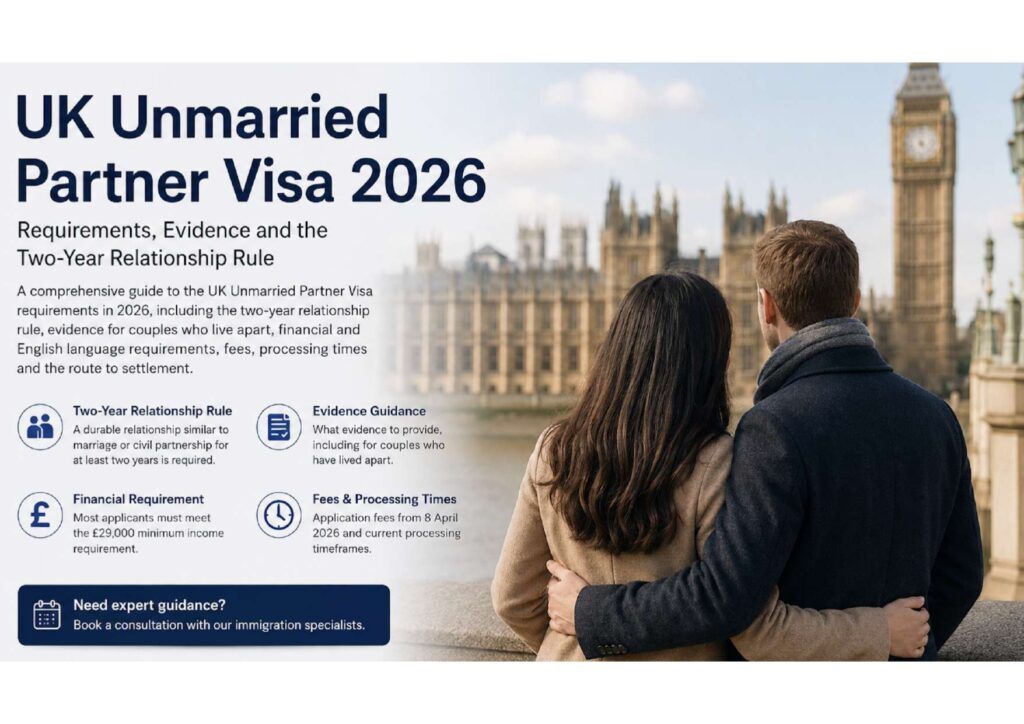
An applicant does not have to be married or in a civil partnership to join their partner in the United Kingdom. The UK Unmarried Partner Visa allows qualifying couples to establish or continue their family life in the UK where their relationship has reached a level of commitment comparable to marriage or civil partnership.
The most common misunderstanding is that the couple must have lived together continuously for two years. That is not the current legal test. The couple must instead show that they have been in a durable relationship similar to marriage or civil partnership for at least two years before the application date.
Cohabitation remains strong evidence, but it is not mandatory. Couples may qualify where they have lived in different countries or at separate addresses because of work, study, immigration restrictions, cultural expectations or another credible reason. Where cohabitation is limited or absent, however, the evidence must show that the relationship has developed beyond ordinary dating and involves a genuine, continuing commitment to a shared life.
This guide explains the 2026 requirements, including the two-year relationship rule, evidence for couples living apart, the financial and English-language requirements, application fees, common refusal risks and the route to settlement.
Unmarried Partner Visa 2026: Key Points
The relationship must have been similar to marriage or civil partnership for at least two years.
Two years of continuous cohabitation is not required.
Couples living apart must explain why and provide persuasive evidence of continuing commitment.
Most new applicants must meet a minimum income requirement of £29,000.
The standard route can lead to indefinite leave to remain after five years.
What Is a UK Unmarried Partner Visa?
The Unmarried Partner Visa is part of the family route under Appendix FM. It is mainly used by the unmarried partners of British or Irish citizens, people settled in the UK and certain other qualifying sponsors. A successful applicant can normally work, undertake self-employment and study, but will usually have no recourse to public funds.
An initial overseas application is normally granted for two years and nine months. An extension or in-country switch is normally granted for two years and six months. After five years on the standard route, the applicant may qualify for indefinite leave to remain through the spouse and partner route.
Is This the Correct Visa Route?
The correct route depends on the legal status of the relationship and the immigration position of the UK-based partner.
| Circumstances | Normally relevant route |
|---|---|
| The couple are unmarried and have been in a durable relationship for at least two years | Unmarried Partner Visa |
| The couple are legally married | Spouse Visa |
| The couple intend to marry or form a civil partnership in the UK | Fiancé, fiancée or proposed civil partner visa |
| The UK-based partner holds a qualifying work, study or business visa | Dependant Partner Visa |
| The applicant intends to marry in the UK and then leave | Marriage Visitor Visa |
An unmarried partner of a Skilled Worker, Global Talent migrant, Innovator Founder or another temporary visa holder would usually apply as that person’s dependant rather than under Appendix FM.
Who Can Sponsor an Unmarried Partner?
Both parties must be at least 18, have met in person, be in a genuine and subsisting relationship and intend to live together permanently in the UK. The sponsor will normally be British or Irish, settled in the UK, an eligible person with pre-settled status or someone holding another qualifying status under Appendix FM. Any previous marriage, civil partnership or durable relationship must have permanently broken down.
The Two-Year Relationship Rule
The Immigration Rules Appendix Relationship with Partner defines an unmarried partner as a person who has been in a durable relationship similar to marriage or civil partnership for at least two years before applying.
This requires more than showing that the couple first met two years ago. The Home Office may consider when the relationship became committed, how regularly the parties met, whether they supported each other and whether their lives became financially, emotionally or practically connected. Two years of dating does not automatically establish a durable partnership.
Is Two Years of Cohabitation Required?
No. The Home Office relationship-with-a-partner guidance confirms that there is no requirement for the couple to have lived together for two years, provided the relationship is similar to marriage or civil partnership.
Cohabitation remains persuasive because it often creates official records such as tenancies, Council Tax documents, utility bills and bank correspondence. Where the couple live apart, the application should explain why. Relevant circumstances may include work, study, immigration restrictions, cultural expectations or caring responsibilities.
A couple who have never lived together can still qualify, but the evidential burden is greater. A sustained history of visits, regular communication, financial support, family involvement and firm plans to live together will usually be more persuasive than photographs and messages alone.
Our Practical Assessment of Evidential Risk
The table below is not a separate Home Office legal test. It is a practical indication of how different relationship histories may affect the preparation required.
| Relationship history | Practical assessment |
|---|---|
| More than two years’ cohabitation supported by consistent official records | Usually the clearest evidential profile |
| Previous cohabitation followed by temporary separation for work, study or immigration reasons | Normally manageable if the separation is explained and commitment continues |
| No cohabitation, but frequent visits, regular communication, family involvement and financial support | Potentially viable, but requires careful evidence |
| Mainly online contact, few meetings and limited shared commitments | Higher risk because the evidence may establish dating rather than a durable partnership |
| Contradictory dates, unexplained gaps or previous applications describing the relationship differently | High risk until the inconsistencies are addressed |
The strongest applications do not hide periods of separation or weaknesses in the evidence. They explain them and present the relationship as a coherent chronology.
How to Prove a Durable and Genuine Relationship
The applicant must prove the relationship on the balance of probabilities. Official and verifiable evidence generally carries more weight than personal statements, photographs or social-media messages.
For couples who have lived together, useful documents include tenancies, mortgage records, Council Tax bills, utilities, bank statements and medical or government correspondence. Documents need not all be jointly addressed if separate records show both partners at the same address during the same period.
Financial or practical commitment may be shown through joint accounts, regular transfers, shared expenses, insurance, travel costs or responsibility for children. Couples living apart may rely on travel records, visits, call logs, selected messages and work, study or immigration records explaining the separation.
There is no fixed requirement for six documents or one item every three months. The evidence should be proportionate, credible and cover the development of the relationship.
Preparing the Relationship Statement
A relationship statement is especially useful where cohabitation is limited or absent. It should explain how the couple met, when the relationship became committed, periods of cohabitation or separation, how they maintained contact, their shared responsibilities and their future plans.
Dates should be checked against passports, tickets, tenancies and previous applications. Separate statements should be consistent without appearing artificially identical.
Financial Requirement
Most new applicants under the five-year partner route must satisfy the current £29,000 minimum income requirement.
Permitted sources include employment, self-employment, pensions, specified non-employment income and cash savings. An overseas applicant’s employment income will not normally count, whereas qualifying UK income earned by an applicant lawfully permitted to work may potentially be combined with the sponsor’s income.
If the entire requirement is met through cash savings, the amount normally needed is £88,500:
£16,000 + (£29,000 × 2.5) = £88,500
The savings must generally have been held for at least six months and be under the control of the applicant, sponsor or both.
Applicants continuing with the same partner after a successful application made before 11 April 2024 may remain under the previous £18,600 threshold. Where the sponsor receives certain specified disability or carer’s benefits, an adequate-maintenance test may apply instead.
Self-employment, recent job changes, variable income and family-controlled companies require particular care under Appendix FM-SE.
English-Language and Accommodation Requirements
A first partner application normally requires speaking and listening at CEFR level A1, rising to A2 at extension and B1 plus the Life in the UK Test at settlement, unless an exemption applies.
Adequate accommodation must be available without additional recourse to public funds and must not be statutorily overcrowded. Evidence may include a tenancy agreement, title document, mortgage statement or landlord’s consent. A property inspection report may help where the household is large or the room arrangements are unclear.
Applying From Outside or Inside the UK
An applicant living overseas must normally obtain entry clearance before travelling to the UK to settle with their partner.
A person already in the UK may be able to switch where they hold eligible permission. A visitor, or someone granted permission for six months or less, cannot normally switch and will usually need to apply from overseas.
Time spent under another visa does not normally count towards the five-year Appendix FM settlement period.
Fees and Processing Times in 2026
The principal application fees effective from 8 April 2026 are:
| Application | Home Office fee |
|---|---|
| Partner application from outside the UK | £2,064 |
| Partner extension or switch inside the UK | £1,407 |
| Priority service, where available | £500 |
| Super Priority service, where available | £1,000 |
Most adult applicants must also pay the Immigration Health Surcharge at £1,035 per year. This normally produces an IHS charge of £3,105 for an initial overseas application and £2,587.50 for a 30-month in-country grant.
A standard overseas partner application is usually decided within approximately 12 weeks. A standard in-country application meeting the ordinary financial and English-language requirements is usually decided within approximately eight weeks.
Faster services may be available, but paying for priority processing does not guarantee approval.
Common Reasons for Refusal
Unmarried partner applications commonly encounter difficulty where:
the couple apply before completing the qualifying two-year relationship period;
the evidence shows dating but not a durable partnership;
separate addresses are not properly explained;
the relationship timeline contains contradictions;
the wrong financial category or documents are used;
a visitor attempts to switch from inside the UK;
previous relationships, refusals, overstaying or criminal matters are not disclosed.
A genuine relationship does not correct an invalid route, missing financial evidence or inconsistent information. The application must satisfy all relevant requirements on the date of submission.
What Happens After the Visa Is Granted?
A successful applicant can normally work, undertake self-employment and study. Before expiry, they must apply for an extension and show that the relationship and other requirements remain satisfied.
If the couple later marry or form a civil partnership, the five-year partner period does not normally restart where the applicant remains with the same partner.
After 60 months on the standard route, the applicant may apply for ILR. Time spent as a fiancé or under an unrelated visa does not normally count.
An unmarried partner of a British citizen will generally need to hold ILR for 12 months before applying for naturalisation under the standard provisions.
What If the Standard Requirements Cannot Be Met?
Where the ordinary financial, English-language or immigration-status requirements are not met, the Home Office may need to consider whether refusal would cause unjustifiably harsh consequences or breach Article 8 rights.
This may be relevant where there is a British or Irish child, or a child who has lived in the UK for at least seven years and it would be unreasonable to expect the child to leave.
These provisions are not a routine alternative to the Rules. A grant may place the applicant on a ten-year route to settlement. Advice may be required concerning Private Life or Article 8 Human Rights provisions.
How E&S Consultancy UK Limited Can Assist
E&S Consultancy UK Limited provides professional spouse and partner visa application support for applications submitted from inside and outside the UK.
Our work can include assessing the two-year durable-partner requirement, reviewing gaps in cohabitation, identifying the correct financial category, preparing an evidence strategy and reviewing the application and supporting documents.
We can also prepare legal representations in complex long-distance, financial, refusal or human-rights cases.
Frequently Asked Questions
Do unmarried partners have to live together for two years?
No. The relationship must have been similar to marriage or civil partnership for at least two years, but continuous cohabitation is not mandatory.
Can we apply if we have never lived together?
Potentially, yes. You must explain why you have not cohabited and provide evidence of an ongoing commitment comparable to marriage or civil partnership.
Is two years of dating sufficient?
Not automatically. The Home Office considers the nature and substance of the relationship as well as its duration.
Can a visitor switch to an Unmarried Partner Visa?
Usually not. A visitor will normally need to leave the UK and apply from overseas unless a specific exception or compelling human-rights basis applies.
Can an unmarried partner work in the UK?
Yes. A person granted permission under the standard partner route can normally work, undertake self-employment and study.
Does the route lead to settlement?
Yes. A person on the standard five-year route may normally apply for indefinite leave to remain after completing 60 months and meeting the settlement requirements.
Arrange an Unmarried Partner Visa Consultation
The unmarried partner route recognises that genuine couples do not always live together continuously before applying. However, where cohabitation is limited or absent, the evidence must show clearly how the relationship developed, why the parties lived apart and why their commitment is comparable to marriage or civil partnership.
Applicants who are uncertain whether their evidence meets the two-year durable-partner test can complete our free UK visa assessment or arrange a consultation with E&S Consultancy UK Limited.
Schedule a consultation
Telephone: +44 (0) 208 947 0810 or +44 (0) 7852 771100
Email: info@esconsultancy.co.uk
About the Author
Elshad Huseynov is the Founder and Principal Consultant at E&S Consultancy UK Limited. He holds a PhD in Law from the University of London and has more than 25 years of experience in immigration law and related advisory work, including spouse and partner applications and corporate immigration matters.
This article provides general information and does not constitute immigration advice for an individual application. Immigration Rules, fees and processing times may change.