
Last updated: 4 July 2026
Originally published: 13 August 2025
By Elshad Huseynov (PhD in Law), E&S Consultancy UK Limited
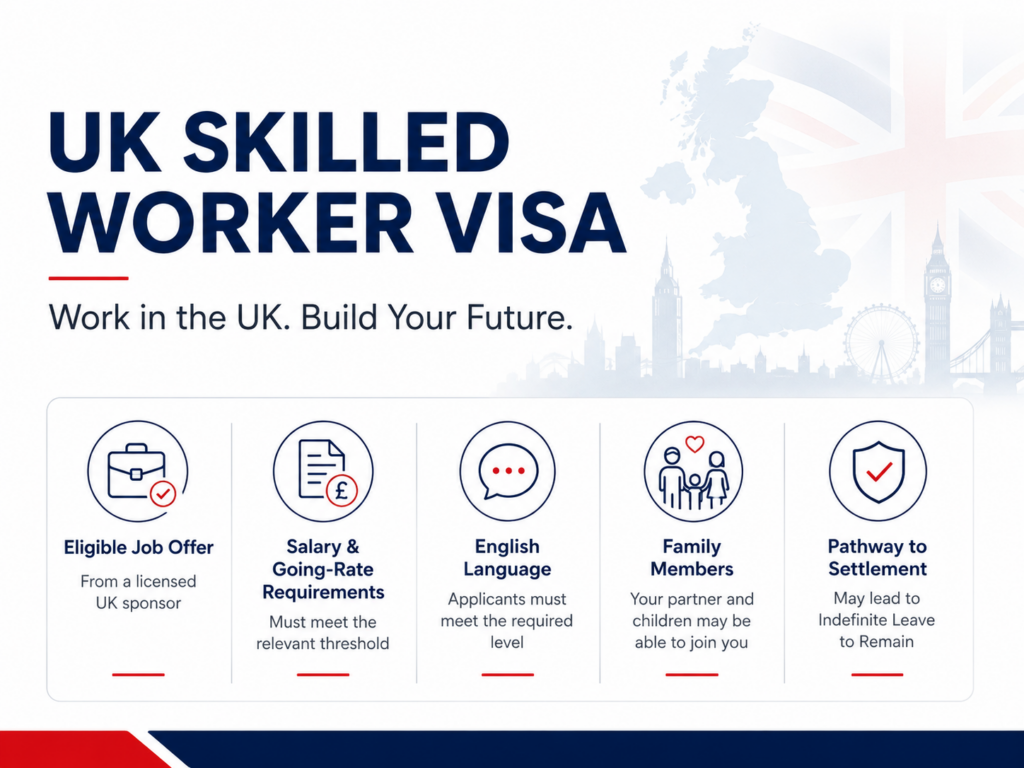
The Skilled Worker Visa is the principal UK immigration route for overseas nationals who have been offered an eligible job by a Home Office-approved employer. It can allow a worker to live and work in the United Kingdom, bring qualifying family members and, in many cases, apply for indefinite leave to remain after five years.
The route has become substantially more technical. Most new applicants must now be sponsored in a job at RQF level 6 or above, meet a salary requirement that is usually at least £41,700 or the occupation’s going rate, and demonstrate English at B2 level.
Different rules may apply to healthcare and education roles, new entrants, relevant PhD holders, occupations on the Immigration Salary List or Temporary Shortage List and workers protected by transitional provisions.
A job title alone does not establish eligibility. The Home Office will consider the actual duties, the correct occupation code, the salary calculation, the employer’s sponsor licence and the worker’s immigration history.
This guide explains the Skilled Worker Visa requirements applying in 2026 and the checks that applicants and employers should complete before a Certificate of Sponsorship is assigned.
Skilled Worker Visa 2026: Key Points
The applicant needs a genuine job offer from a licensed UK sponsor.
The role must have the correct eligible occupation code.
The usual salary requirement is £41,700 and the applicable going rate, whichever is higher.
Most first-time applicants from 8 January 2026 need English at B2 level.
Most new applicants must be sponsored in a job at RQF level 6 or above.
Medium-skilled roles are subject to restricted lists and transitional provisions.
The route can lead to indefinite leave to remain after five qualifying years.
What Is a Skilled Worker Visa?
The Skilled Worker Visa allows a qualifying overseas national to work in a specific eligible job for an approved UK employer. It replaced the Tier 2 General route. The employer must hold an appropriate Skilled Worker sponsor licence and assign the applicant a valid Certificate of Sponsorship before the visa application is submitted.
The visa is connected to the sponsored employment. A worker cannot freely move to another employer or begin a materially different sponsored role without checking whether a new Certificate of Sponsorship and visa application are required. Permission may be granted for up to five years at a time. It can be extended as long as the worker, employer and role continue to satisfy the requirements.
Who Can Apply for a Skilled Worker Visa?
Under Appendix Skilled Worker of the Immigration Rules, an applicant must normally satisfy four main requirements:
Sponsorship by a Home Office-approved UK employer;
A genuine vacancy in an eligible occupation;
The applicable salary requirement; and
The English-language requirement.
The applicant must also satisfy the validity, financial and suitability requirements. Depending on the job and country of application, additional documents may include a tuberculosis certificate, criminal record certificate or Academic Technology Approval Scheme certificate.
A university degree is not mandatory for every Skilled Worker application. The job must meet the relevant skill threshold, but the applicant only needs a specific qualification where it is required by the occupation, professional regulator or salary option relied upon.
The Sponsor Licence and Certificate of Sponsorship
An employer cannot sponsor a Skilled Worker unless it holds the appropriate sponsor licence. The employer assigns an electronic Certificate of Sponsorship containing information about the worker, the job title and duties, the occupation code, the salary and weekly hours, the work location, the proposed employment dates and the salary option being relied upon.
The Certificate of Sponsorship is not a paper certificate and does not itself grant permission to work. It is a digital sponsorship record used to support the visa application. The visa application must normally be submitted within three months of the certificate being assigned. The proposed start date stated on the certificate must also normally be no more than three months after the visa application date.
A Certificate of Sponsorship does not guarantee approval. The Home Office can refuse the application where the certificate contains inaccurate information, the vacancy is not genuine or the occupation code and salary do not match the actual job.
Genuine Vacancy and Correct Occupation Code
The sponsor must select the occupation code that most accurately reflects the work the applicant will perform. The Home Office may examine the detailed job description, the employer’s business activities, the organisation’s size and structure, the level of responsibility, the applicant’s qualifications and experience, the salary offered and whether the vacancy makes commercial sense.
A senior-sounding job title does not turn an administrative or operational position into an eligible managerial role. The Home Office may also question a vacancy where the duties appear to have been copied from the occupation-code description but do not match the employer’s genuine operational needs.
Employers and applicants should assess the substance of the role against the official Skilled Worker eligible occupation list before the Certificate of Sponsorship is assigned.
Which Jobs Are Eligible in 2026?
Since 22 July 2025, the general skill threshold for new Skilled Worker applicants has been RQF level 6, broadly equivalent to graduate level. This does not mean that every applicant must hold a degree. It means that the occupation itself must normally be classified at the required skill level.
Many eligible higher-skilled occupations are found in technology, engineering, science, healthcare, education, finance, law. architecture and senior management. Some jobs classified as medium skilled at RQF levels 3 to 5 remain eligible where they appear on the Immigration Salary List or the Temporary Shortage List.
Transitional provisions may also allow certain workers who entered the Skilled Worker route before 22 July 2025 to extend their permission or change employment in a medium-skilled occupation.
| Occupation type | General position in 2026 |
|---|---|
| Higher-skilled occupation at RQF level 6 or above | Generally eligible if the remaining requirements are met |
| Medium-skilled role on the Immigration Salary List | May be eligible, subject to the occupation-specific conditions |
| Medium-skilled role on the Temporary Shortage List | May be eligible, but dependant and salary-discount restrictions apply |
| Medium-skilled role not on either list | Usually unavailable to a new applicant |
| Existing Skilled Worker first sponsored before 22 July 2025 | Transitional protection may allow continued sponsorship in a medium-skilled role |
The Immigration Salary List and Temporary Shortage List are not identical. An occupation on the Temporary Shortage List does not automatically qualify for the reduced visa fee or Immigration Salary List salary treatment.
Special Restrictions for Care Workers
Care workers and senior care workers are subject to additional restrictions. New overseas recruitment into the relevant care-worker occupation codes is generally closed under the current rules, although limited in-country and transitional applications may remain possible.
A person already in the UK may, in certain circumstances, be sponsored as a care worker or senior care worker if they have worked legally for the sponsor in the relevant role for the required period before the Certificate of Sponsorship is assigned.
There are also significant restrictions on bringing partners and children. Employers and workers should check the exact rules before relying on a care-sector job offer.
Skilled Worker Salary Requirements
The salary rules generally require the applicant to satisfy both:
A general annual salary threshold; and
The going rate for the occupation code.
The standard is at least £41,700 per year and 100% of the going rate for the occupation, whichever is higher. Each occupation code has its own salary rate. The official Skilled Worker going-rates tables should be checked alongside the annual threshold.
Going rates are normally based on a 37.5-hour working week and must be adjusted where the worker’s weekly hours are different. For example, a salary of £42,000 does not satisfy the standard rule where the correctly adjusted going rate for the occupation is £46,000.
When Can a Worker Be Paid Less?
A lower salary may be accepted where the applicant qualifies for one of the permitted salary options. These may include:
| Salary option | Typical minimum annual threshold | Going-rate requirement |
|---|---|---|
| Standard application | £41,700 | 100% |
| Relevant non-STEM PhD | £37,500 | 90% |
| Relevant STEM PhD | £33,400 | 80% |
| New entrant | £33,400 | 70% |
| Immigration Salary List occupation | £33,400 | Full applicable going rate |
| Certain healthcare or education roles | Different threshold | Relevant national or occupation rate |
These figures cannot be applied without checking the detailed conditions. The official guidance explains when a Skilled Worker can be paid less. Our separate employer guide provides a fuller explanation of the minimum salary for Skilled Worker sponsorship in 2026.
Who Qualifies as a New Entrant?
A new entrant is not simply someone making their first Skilled Worker application. The category may include:
an applicant under 26 on the application date;
certain current or recent Student visa holders;
certain Graduate visa holders;
someone working towards recognised professional status;
someone working towards full registration or chartered status; or
an applicant sponsored in a qualifying postdoctoral role.
The total period during which a person may rely on new-entrant provisions is generally limited to four years. Relevant time already spent under the Graduate route is included in that period. The proposed visa duration should therefore be checked before relying on the new-entrant salary discount.
Transitional Salary Protection
Workers who were granted Skilled Worker permission under the Rules applying before 4 April 2024 and have held continuous Skilled Worker permission since then may qualify for transitional salary treatment.
The standard transitional requirement may be at least £31,300 and the applicable lower going rate, although different provisions apply to some healthcare, education, PhD, new-entrant and Immigration Salary List cases.
Transitional protection is not established merely because the applicant has lived or worked in the UK for several years. The assessment should consider the date of the first Skilled Worker Certificate of Sponsorship, whether permission has remained continuous, the occupation code, the present job and salary, whether the applicant is extending or changing employer and whether another salary option applies.
The worker’s full immigration history should be reviewed before a new Certificate of Sponsorship is assigned.
English-Language Requirement in 2026
A person making their first Skilled Worker application from 8 January 2026 must normally demonstrate English in reading, writing, speaking and listening at CEFR level B2.
The current Skilled Worker English-language guidance explains the methods by which the requirement can be met. These include:
an approved Secure English Language Test;
an eligible UK qualification;
an overseas degree taught in English and assessed through Ecctis; or
nationality of a recognised majority English-speaking country.
A worker who already held Skilled Worker permission before 8 January 2026 and is extending or updating that permission may remain subject to the previous B1 requirement. They will not normally need to prove English again where it was accepted in the earlier application.
A person switching from another immigration route after 8 January 2026 will normally need to satisfy B2, even if they have previously held permission in the UK.
Switching to Skilled Worker From Inside the UK
Many people can switch to the Skilled Worker route from inside the UK, including qualifying Student and Graduate visa holders. A person cannot normally switch where their current or most recent permission is as a:
Visitor;
Short-term Student;
Parent of a Child Student;
Seasonal Worker; or
Domestic Worker in a Private Household.
A person on immigration bail or holding permission outside the Immigration Rules also cannot normally switch. Students are subject to additional course-completion conditions. They will generally need to have completed the course for which their Confirmation of Acceptance for Studies was issued, or the sponsored job must begin after the course completion date. A PhD student may be able to switch after completing at least 24 months of study.
The official rules are explained in the Skilled Worker switching guidance. Our separate article examines when an employer can sponsor a worker who is already in the UK.
Maintenance Funds
An applicant who is applying from overseas, or who has been lawfully in the UK for less than 12 months, will normally need to show at least £1,270 unless the employer will support the maintenance requirements.
The money must usually have been held for at least 28 consecutive days. Alternatively, an A-rated sponsor can certify maintenance on the Certificate of Sponsorship. An applicant who has already been living lawfully in the UK for at least 12 months will normally not need to provide separate maintenance evidence. Where eligible dependants apply, the additional maintenance amounts are normally:
£285 for a dependent partner;
£315 for the first dependent child; and
£200 for each additional dependent child.
Can Partners and Children Apply?
A qualifying partner and dependent children can often accompany or join a Skilled Worker. Each dependant submits a separate application. However, dependant rights are restricted for care workers, senior care workers; and workers sponsored in certain medium-skilled occupations.
A new worker sponsored through the Temporary Shortage List will generally be unable to bring dependants unless a transitional or specific exception applies. The official Skilled Worker dependant guidance should be checked before the worker accepts the role or the family makes travel plans. A person’s eligibility for the main Skilled Worker Visa does not automatically mean that their partner and children are eligible.
Documents Commonly Required
A Skilled Worker applicant will normally need:
a valid passport;
the Certificate of Sponsorship reference;
evidence of English where required;
maintenance evidence unless exempt;
a tuberculosis certificate where applicable;
a criminal record certificate for specified occupations;
an ATAS certificate where required; and
relationship evidence for accompanying dependants.
The Home Office may request additional documents concerning the applicant’s qualifications, occupation, salary or employment arrangements. Documents not written in English or Welsh will normally require a compliant translation.
Application Process
The practical application process is:
confirm that the employer holds the correct sponsor licence;
identify the correct occupation code;
check the skill level and salary requirements;
assign the Certificate of Sponsorship;
submit the online visa application;
pay the application fee and Immigration Health Surcharge;
verify identity through the application app or biometric appointment; and
respond to any Home Office request for further information.
Applicants should not resign from existing employment, begin the new job or make irreversible travel arrangements without considering the effect on their immigration position. A person changing employer should normally wait until the new visa application has been approved before beginning work for the new sponsor.
Skilled Worker Visa Fees in 2026
The following application fees apply from 8 April 2026:
| Application | Up to three years | More than three years |
|---|---|---|
| Applying from outside the UK | £819 | £1,618 |
| Extending, switching or updating inside the UK | £943 | £1,865 |
| Immigration Salary List application | £628 | £1,235 |
| Health and Care Visa | £324 | £628 |
These figures are taken from the Home Office immigration and nationality fee schedule effective from 8 April 2026. Most Skilled Worker applicants must also pay the Immigration Health Surcharge, currently £1,035 for each year of permission. Qualifying Health and Care Visa applicants and their eligible dependants do not pay the Immigration Health Surcharge. The employer is normally responsible for the Certificate of Sponsorship fee and, where applicable, the Immigration Skills Charge. These are separate from the worker’s visa fee.
Processing Times
A Skilled Worker application is normally decided within:
three weeks when submitted outside the UK; or
eight weeks when submitted inside the UK.
These are the standard published processing periods in the official Skilled Worker Visa guidance. Priority and Super Priority services may be available for an additional fee. Availability varies and faster processing does not guarantee approval.
The application can take longer where the Home Office needs to verify documents, request further information, conduct checks or interview the applicant.
Changing Employer, Job or Occupation Code
A Skilled Worker normally needs to update their visa before changing to a new sponsor. A new application may also be required where the worker changes occupation code, moves into a materially different role, changes from a role on the Immigration Salary List, changes from a role subject to transitional protection or adds a second sponsored job exceeding the supplementary-work limit.
The new employer must assign a fresh Certificate of Sponsorship. A worker can normally continue working for their existing sponsor while a valid in-time application is pending, but should not begin the new sponsored employment until the application has been approved. The official procedure is set out in the change of job or employer guidance.
Supplementary Employment
A Skilled Worker may undertake supplementary employment outside the hours of the sponsored job, normally for up to 20 paid hours each week, provided the additional work satisfies the applicable requirements and the worker continues in the sponsored role.
If the additional work exceeds 20 paid hours each week, the worker will normally need a second Certificate of Sponsorship and an application to update their visa.The supplementary-work rules can be more restrictive for medium-skilled occupations and workers relying on transitional provisions.
Indefinite Leave to Remain
The Skilled Worker route can lead to settlement after five qualifying years. The qualifying period may include certain combinations of Skilled Worker, Global Talent, Innovator Founder, Scale-up and other specified routes.
The applicant must satisfy the continuous-residence requirement, normally including no more than 180 days’ absence during any rolling 12-month period.
The sponsor must normally confirm that the worker remains required for the foreseeable future. The applicant must also meet the settlement salary requirement applying to their circumstances.
The official Skilled Worker settlement guidance should be checked before applying. Under the currently published Rules, Skilled Worker settlement applications made on or after 26 March 2027 will normally require English speaking and listening at B2 unless an exemption applies. For professional support with settlement, see our Indefinite Leave to Remain service.
Common Reasons for Refusal
Common problems include:
using an incorrect occupation code;
salary falling below the general threshold or going rate;
a vacancy that is not considered genuine;
inconsistencies on the Certificate of Sponsorship;
insufficient English-language evidence;
missing maintenance evidence;
attempting to switch from a prohibited immigration category;
failure to disclose previous refusals or immigration breaches; and
discrepancies between the job description, contract, application and sponsor records.
The job, salary and Certificate of Sponsorship should be reviewed together rather than treated as separate documents.
How E&S Consultancy UK Limited Can Assist
E&S Consultancy UK Limited provides professional Skilled Worker Visa application support to applicants and UK employers.
We can assess the occupation code, the skill level, the salary option, the English-language requirement, eligibility to switch inside the UK, transitional salary protection, dependant eligibility and the Certificate of Sponsorship before assignment.
We also assist with sponsor licences, extensions, changes of employment, dependant applications and settlement planning.
Where the role, occupation code or salary is borderline, obtaining advice before assigning the Certificate of Sponsorship can prevent an unsuitable certificate and an avoidable visa refusal.
Frequently Asked Questions
What is the minimum Skilled Worker salary in 2026?
The usual requirement is at least £41,700 and the full going rate for the occupation, whichever is higher. Lower thresholds can apply under specific salary options.
Do I need a university degree?
Not necessarily. The job must meet the relevant skill level, but a degree is only required where the occupation, professional regulator or salary option requires one.
Can I switch from a Graduate Visa?
Yes, provided the job, salary, sponsorship and B2 English requirements are met.
Can I switch from a Visitor Visa?
No. A visitor must normally leave the UK and apply for Skilled Worker entry clearance from overseas.
Can I bring my family?
Often yes, but restrictions apply to care workers, senior care workers and certain medium-skilled occupations.
Can I change employer?
Yes, but the new employer must normally assign a fresh Certificate of Sponsorship and the worker must obtain updated Skilled Worker permission before starting the new role.
Can the Skilled Worker Visa lead to settlement?
Yes. A Skilled Worker may normally apply for indefinite leave to remain after five qualifying years if the continuous-residence, salary, sponsorship and knowledge-of-life requirements are met.
Arrange a Skilled Worker Visa Assessment
A Skilled Worker application should be assessed before the Certificate of Sponsorship is assigned.
The correct outcome depends not only on the job title, but on the actual duties, occupation code, salary calculation, sponsor status and the worker’s immigration history.
Applicants and employers can complete our free UK visa assessment or arrange a consultation with E&S Consultancy UK Limited.
Schedule a consultation
Telephone: +44 (0) 208 947 0810 or +44 (0) 7852 771100
Email: info@esconsultancy.co.uk
About the Author
Elshad Huseynov is the Founder and Principal Consultant at E&S Consultancy UK Limited. He holds a PhD in Law from the University of London and has more than 25 years of experience in immigration law and related advisory work, including Skilled Worker applications, sponsor licences and corporate immigration compliance.
This article provides general information and does not constitute immigration advice for an individual application. Immigration Rules, fees, salary thresholds and processing times may change.